Safety
Soft toys and safe sleep: where a lovey belongs at night
The safety bodies give one short answer about what goes in a sleep space. Here it is in their words, with what it means for the lovey a baby has settled on and for the rest of the day.
This is the question we get most, and it is the one where our opinion is worth the least. So this page quotes the bodies that publish guidance and stays out of the way.
The short version is that a sleep space is bare. Not tidy, not minimal. Bare.
What the guidance says
The safest way for a baby to sleep is flat on their back without pillows, blankets, or toys in their sleep space.
U.S. Consumer Product Safety Commission, Safe Sleep: Cribs and Infant Products. Read 11 September 2026.
The second source says the same thing from the other direction, which is worth reading because it answers the feeling most parents have when they look at an empty crib.
Even though a crib with nothing in it except a fitted sheet covering the mattress may seem bare, it is the safest option for baby.
Eunice Kennedy Shriver National Institute of Child Health and Human Development, Safe Sleep Environment for Baby. Read 11 September 2026.
That is the whole of it. No toys, no blankets, no pillows, no bumper, no lovey, for the first year. We are not adding a caveat to that, because we have nothing to add to it.
What a lovey is for, then
Everything that is not sleep. Arms, laps, floor time, the pram, the car seat, the change table, the trolley. That is most of a baby's waking day, and a comfort object works in all of it.
It also does the thing parents actually want from it. A child who has a familiar object in the day settles faster in unfamiliar places, and none of that requires the object to be in the cot overnight.
- 1. Arms, lap and floorA soft toy belongs in arms, on a lap or on the pram bar, not in the sleep space.
- 2. Read the seams with a thumbSeams and embroidery are where a soft toy gives first, and a thumb finds it before an eye does.
- 3. An opened seam ends that toyOnce stitching opens on a stuffed piece, it is finished rather than mendable.
After the first year
Guidance on when a soft toy can move into a bed is set by paediatric bodies and by your own doctor, not by a review site. What we can say is what changes physically: after twelve months a child rolls, sits and clears their own face, and the small flat objects in this line are the kind most often allowed first.
If you want a specific answer for your child, that is a question for the paediatrician at a check-up. It is one of the few questions where a five second answer from someone who knows the child beats an article.
What to look for in the toy itself
Whatever a piece is for, the same two things decide whether it is sound: what can come off it, and whether the seams hold.
Place the article, without compressing it, into the cylinder. If the article fits entirely within the cylinder, in any orientation, it fails to comply with the test procedure.
Electronic Code of Federal Regulations, 16 CFR part 1501: small parts and the test cylinder. Read 15 September 2026.
That cylinder is the test behind every embroidered face in this line. Plastic eyes, glued noses and tied-on bows are the parts that fail it, and their absence is the reason these pieces are sold for the first year at all.
The regulation names our category in its own scope, which is a useful thing to know when a page is vague about age.
stuffed, plush, and flocked animals and other figures
Electronic Code of Federal Regulations, 16 CFR part 1501: small parts and the test cylinder. Read 15 September 2026.
Three habits that matter more than the model
Check the seams weekly, with a thumb rather than an eye. Keep the sleep space bare and let the toy live in the day. Retire a piece the moment stitching opens, rather than mending it.
None of that depends on which lovey you bought, and all of it outlasts any ranking on this page.
Questions we get
Our baby will only sleep holding the lovey. What now?
That is a question for your paediatrician about your child, and they will answer it in a minute. The published guidance above does not carve out an exception, and neither will we.
Is a small lovey safer than a big blanket?
The guidance does not rank them. It says the sleep space holds a fitted sheet and nothing else, which covers both.
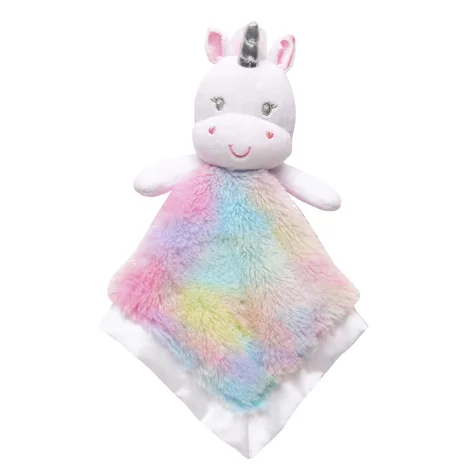
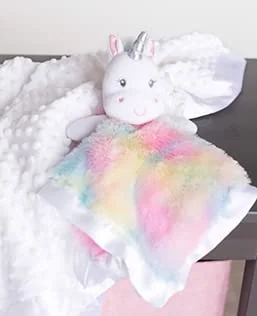
- a small square of blanket with a head on one corner
- light enough for a baby to lift at three months
- one edge in satin, which is the part small hands find first
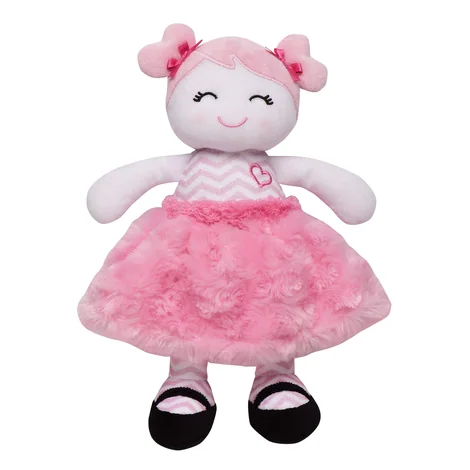
- a body rather than a square, so there is more to hold
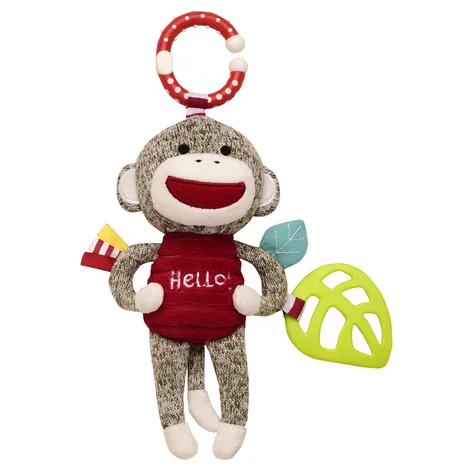
- the rattle sits inside the body, not on a stick
- usually the one a baby takes to after six months
What about a swaddle blanket?
A swaddle is used on the baby rather than laid loose in the cot, and how and when to swaddle is a question for your health visitor or doctor. The blankets in this line are sold as wrap and pram blankets rather than as cot bedding.
Where this came from
Sources we read for this piece
| Source | Published by | Read |
|---|---|---|
| Safe Sleep: Cribs and Infant Products | U.S. Consumer Product Safety Commission | 11 September 2026 |
| Safe Sleep Environment for Baby | Eunice Kennedy Shriver National Institute of Child Health and Human Development | 11 September 2026 |
| 16 CFR part 1501: small parts and the test cylinder | Electronic Code of Federal Regulations | 15 September 2026 |