Care guide
How to wash a lovey without wrecking it
A comfort object gets washed weekly for three years. Here is what the care label is required to tell you, what actually destroys these pieces, and how to keep a satin edge attached to the plush it came with.
A lovey is the only toy in the house that goes through a wash every week. It is dragged on floors, chewed, taken to a nursery and dropped in a car park, and then it has to come back smelling of nothing and feeling the same. Most of them do not survive that for three years, and the reason is almost never the washing.
It is the drying. Heat is what shrinks plush away from a satin edge, flattens the pile and turns a soft square into a stiff one. Everything below follows from that.
Start with the label, because it has to be there
Care labels on textile goods are not a courtesy. In the United States they are regulated, and the rule is specific about what a label is.
Care label means a permanent label or tag, containing regular care information and instructions, that is attached or affixed in such a manner that it will not become separated from the product and will remain legible during the useful life of the product.
Electronic Code of Federal Regulations, 16 CFR part 423: the Care Labeling Rule. Read 15 September 2026.
Two words in that sentence matter to a parent. Permanent means the label is sewn in rather than hung on a string, so you can read it in two years. Legible means it has to survive washing, which is the reason not to cut it off even when a baby chews it.
The rule also puts a duty on the maker to warn you when part of a normal care routine would ruin the thing.
To fail to warn a purchaser, prior to sale, when any part of the prescribed regular care procedure, which a consumer or professional cleaner could reasonably be expected to use, would harm the product or others being cleaned with it
Electronic Code of Federal Regulations, 16 CFR part 423: the Care Labeling Rule. Read 15 September 2026.
So if a label says no tumble dry, that is not a suggestion to hedge against. It is the maker saying that the routine most people would use will harm this piece.
The routine, in order
Cold water, gentle cycle, inside a pillowcase knotted shut. The bag is the part people skip and the part that saves satin edges, ribbon tags and teether ribbons from catching on the drum.
Use a plain detergent and no fabric softener. Softener coats the fibres, and on a plush toy that shows up as a flat, slightly greasy pile after a few washes. Skip bleach entirely, including the oxygen kind, because embroidery threads lose their colour before the body does.
- 1. Cold, gentle, inside a bagA pillowcase knotted shut keeps a satin edge from catching on the drum.
- 2. Press, do not wringWringing is what opens the seam and flattens the stuffing.
- 3. Dry flat, away from heatFlat on a towel keeps the shape. A radiator or a dryer takes it out of the toy for good.
Then press the water out in a towel, do not wring. Wringing is what opens a seam. Dry flat, out of direct sun, away from a radiator. A piece dried flat keeps its shape; a piece hung by the ears comes back longer than it went in.
What each part of the toy wants
| Part | Pieces in this line that have it | What it needs |
|---|---|---|
| Satin edge | 33 | Cold water and a bag. Satin frays where the stitch meets the plush. |
| Rattle sewn in | 27 | Normal wash, then dry flat. The rattle itself is sealed. |
| Crinkle layer | 22 | Cold only. Heat is what silences the crinkle, not water. |
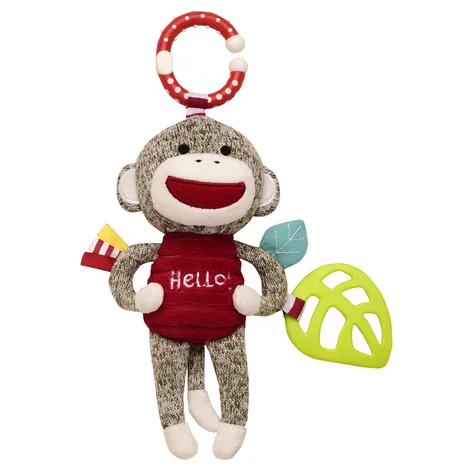
| Teether on a ribbon | 21 | Wash, then check the stitch where the ribbon is sewn in. |
Anything with a sound box or a light is a different case. Those are wiped with a damp cloth and never submerged, and that is the trade you accept when you buy a musical toy.
Check the seams, every time
A wash is the moment a weak seam gives. That is also why it is the best moment to check one, while the piece is in your hands anyway. The standard that covers stuffed toys tests exactly this.
Seams for such toys must not rip during testing.
U.S. Consumer Product Safety Commission, Toy Safety Business Guidance (ASTM F963). Read 15 September 2026.
A new toy has to hold under that test. A toy that has been washed forty times has no such guarantee, and the check takes a thumb and five seconds: along the seam, around the neck, where any ribbon is sewn on.
Once stitching has opened on a stuffed piece, it is finished. Stuffing that a child can reach is the hazard the whole standard exists to prevent, and a hand-sewn repair on a toy that goes in a mouth is not a repair.
The spare, and why it has to be bought early
If a child settles on one piece, buy the second one immediately. Not because the first will wear out, but because it will be left on a train. The rotation also halves how hard each one is worked, which is the only reliable way to get three years out of plush.
Buy the spare while the same colour is still sold. Loveys in this line change character and trim between seasons, and a child who has settled on one face will notice a different one.
When washing is not the answer
A toy that smells after a wash usually has damp trapped in the stuffing, which happens when it is dried folded or in a hurry. Wash it again and dry it flat for a full day before it goes back into use.
A toy that has been through vomit or a nursery illness is a different question, and the honest answer is that a hot wash will ruin it. Most parents accept that and wash hot anyway, and there is no trick that saves both.
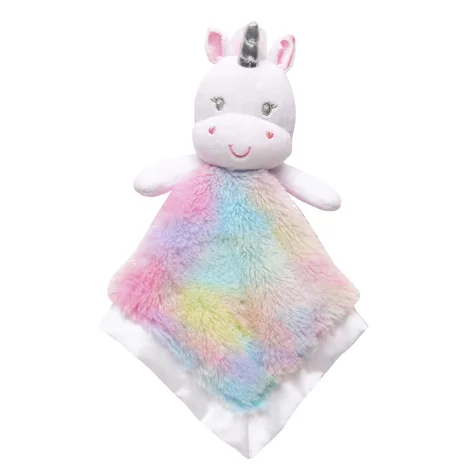
- a small square of blanket with a head on one corner
- light enough for a baby to lift at three months
- one edge in satin, which is the part small hands find first
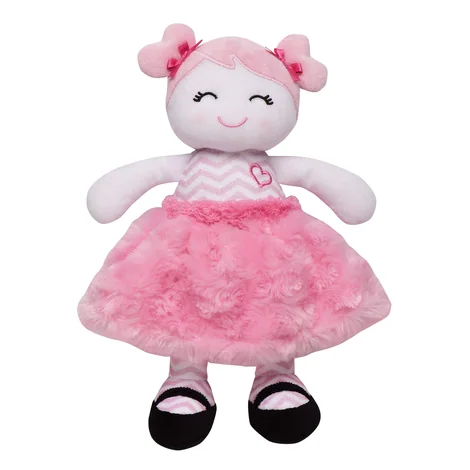
- a body rather than a square, so there is more to hold
- the rattle sits inside the body, not on a stick
- usually the one a baby takes to after six months
Questions we get
Can I put a lovey in the dryer on low?
It will survive a few times and then it will not. Low heat still shrinks the plush away from a satin edge, and once that edge lifts, the toy is on its way out. If you need it dry fast, press it in a towel and put a fan on it.
How often should it be washed?
Weekly for a piece that goes out of the house, and immediately after any illness. More often than that wears it out for no gain.
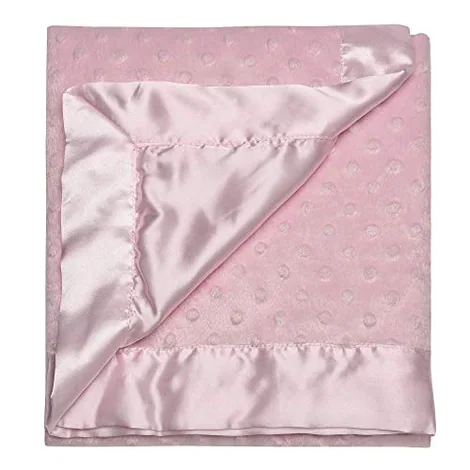
What about a blanket that says two-ply?
Same routine, bigger bag, and expect a longer dry. Two-ply blankets hold water in the middle layer, so a day flat is not excessive.
Where this came from
Sources we read for this piece
| Source | Published by | Read |
|---|---|---|
| 16 CFR part 423: the Care Labeling Rule | Electronic Code of Federal Regulations | 15 September 2026 |
| Toy Safety Business Guidance (ASTM F963) | U.S. Consumer Product Safety Commission | 15 September 2026 |